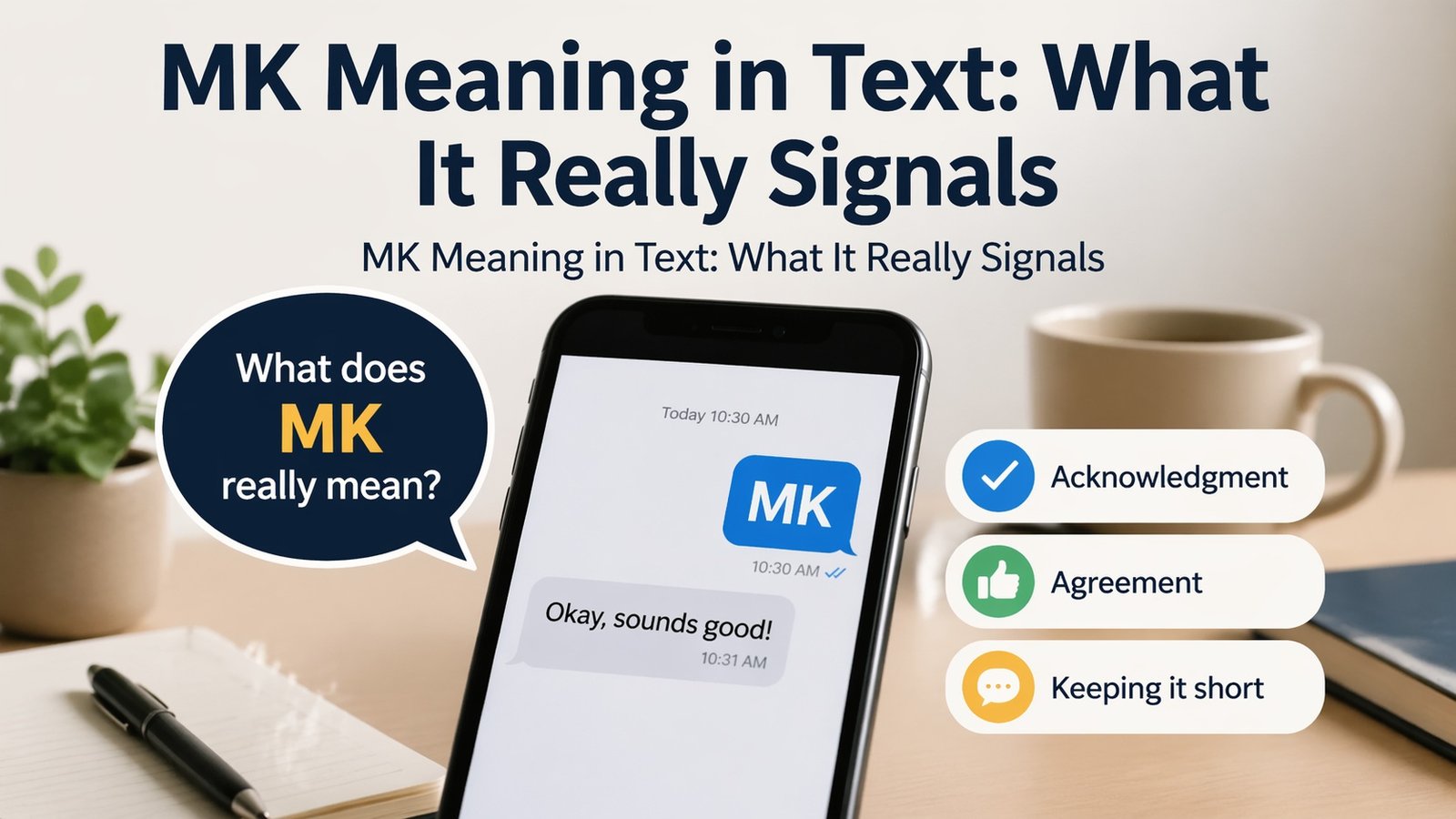
In today’s fast-moving digital world, short replies carry big meaning. One such example is “MK.” At first glance, it looks simple. However, its tone and intent can shift depending on context. That’s why understanding MK Meaning in Text matters more than it seems.
Across the United States, texting culture favors speed and efficiency. People shorten words, drop vowels, and rely on tone instead of full sentences. “MK” fits right into that pattern. It’s quick, subtle, and often emotionally loaded.
Still, not everyone reads it the same way. Some see it as neutral. Others hear a hint of annoyance. So what does it really signal, and where did it come from? Let’s break it down.
Quick Answer
MK Meaning in Text usually means “okay” or “alright,” but with a slightly neutral or passive tone. In the USA, it often signals mild agreement, indifference, or subtle hesitation rather than full enthusiasm.
TL;DR
• “MK” is a short form of “okay”
• Often sounds neutral or slightly dismissive
• Common in casual US texting culture
• Tone depends heavily on context
• Can signal agreement without excitement
• Sometimes used to end conversations quickly
What Does MK Mean in Text?
“MK” is a simplified version of “okay.” It drops the vowel and keeps the sound. That small change shifts the tone.
Basic Meaning
At its core, “MK” means acknowledgment. However, it’s rarely warm or enthusiastic.
• Short for “mmkay” or “okay”
• Signals you received the message
• Often used in casual conversations
• Can feel emotionally flat or distant
Tone Matters
Unlike “OK” or “Okay,” “MK” carries subtle emotional weight.
• Can sound slightly annoyed or uninterested
• May suggest “fine, whatever” in some contexts
• Sometimes used to avoid deeper conversation
• Tone depends on timing and relationship
Where Did MK Come From?
Language evolves quickly, especially online. “MK” didn’t appear overnight.
Early Origins
The sound “mmkay” has been around for years in spoken English. It mimics a thoughtful or reluctant “okay.”
• Derived from spoken hesitation sounds
• Became popular in casual speech
• Reflects informal communication habits
• Later adapted into texting language
Influence of Pop Culture
Pop culture helped shape its tone. Characters in TV and media often used “mkay” in sarcastic or authoritative ways.
• Reinforced slightly dismissive tone
• Made the phrase recognizable
• Added humor or irony in usage
• Helped it spread among younger audiences
MK Meaning in Text in the USA
In the United States, texting habits shape how words feel. “MK” fits into a culture that values speed but also reads between the lines.
Common American Usage
“MK” is widely used in casual chats, especially among younger users.
• Used in quick replies during busy moments
• Signals acknowledgment without commitment
• Often appears in group chats or short exchanges
• Can subtly end a conversation
Cultural Tone
American communication often blends directness with subtle emotional cues. “MK” reflects that balance.
• Not as warm as “okay!”
• Less formal than “alright”
• Slightly more detached than “ok”
• Sometimes interpreted as passive-aggressive
MK vs OK vs K: What’s the Difference?
These small variations can change the entire mood of a message.
Tone Comparison Table
| Context | Meaning in the USA | Common Associations | Notes |
| MK | Neutral or mildly dismissive | Indifference, subtle tone | Can feel passive or distant |
| OK | Standard agreement | Neutral, polite | Safe and widely accepted |
| K | Abrupt acknowledgment | Cold, annoyed | Often seen as rude or curt |
| Okay! | Positive agreement | Friendly, enthusiastic | Adds warmth and energy |
Why It Matters
Even one letter can change perception.
• “MK” softens “K” but cools “OK”
• Tone depends on punctuation and timing
• Context decides emotional meaning
• Relationships influence interpretation
Emotional and Psychological Meaning
Texting isn’t just about words. It’s about feelings behind them.
Emotional Signals
“MK” often reflects emotional distance or restraint.
• Suggests minimal engagement
• Can indicate tiredness or distraction
• May signal mild disagreement
• Sometimes hides frustration
Psychological Interpretation
People read tone based on expectations.
• Short replies can feel dismissive
• Lack of emojis reduces warmth
• Neutral words can seem negative
• Context shapes emotional response
Is MK Rude or Passive-Aggressive?
This is one of the most common questions.
When It Feels Rude
“MK” can come across as cold depending on the situation.
• When used after a long message
• When replacing a more expected reply
• When tone was already tense
• When used repeatedly without explanation
When It’s Harmless
Sometimes, it’s just efficient communication.
• During busy moments
• In casual or close relationships
• When both people use similar style
• In quick confirmations
Read More: 30 Other Ways to Say ‘please let me know professionally’ (With Examples)
How MK Is Used in Social Media and Messaging
Modern communication platforms shape how we use language.
Common Platforms
“MK” appears across many digital spaces.
• Text messages and SMS
• Messaging apps like WhatsApp
• Social media replies
• Online gaming chats
Usage Patterns
People use “MK” for speed and simplicity.
• Quick acknowledgment during multitasking
• Ending a conversation politely
• Responding without emotional investment
• Keeping chats short and efficient
MK in Relationships and Friendships
Tone matters more when emotions are involved.
In Close Relationships
“MK” can signal subtle shifts in mood.
• May hint at annoyance or disagreement
• Can feel distant if overused
• Sometimes used playfully
• Depends on shared communication style
In Professional Contexts
It’s less common in formal communication.
• Can seem too casual or dismissive
• Lacks clarity in tone
• Better replaced with “okay” or “understood”
• May confuse recipients
Cross-Cultural Interpretations of MK
While “MK” is common in the USA, its meaning can vary globally.
Outside the USA
Different cultures interpret brevity differently.
• Some see it as efficient
• Others find it impolite
• Tone may be misunderstood
• Context becomes even more important
Language Differences
Not all languages use similar shorthand.
• Direct translations may not exist
• Tone can be lost in translation
• Cultural norms shape interpretation
• Digital slang varies widely
MK in Modern Identity and Communication Style
The way you text reflects your personality.
Personal Style
Some people naturally use shorter replies.
• Minimalists prefer quick responses
• Busy users favor efficiency
• Younger users adopt slang faster
• Style evolves over time
Social Signals
Your texting style sends subtle messages.
• Short replies can signal confidence
• Or they may suggest disinterest
• Consistency builds understanding
• Sudden changes raise questions
Misunderstandings and Common Confusion
Because tone is unclear in text, “MK” often gets misread.
Common Misinterpretations
People may assume negative intent.
• Thinking it means anger
• Reading it as sarcasm
• Assuming disinterest
• Overanalyzing short replies
How to Avoid Confusion
Clarity helps prevent misunderstandings.
• Add emojis for warmth 🙂
• Use full words in sensitive situations
• Match tone to context
• Ask for clarification if unsure
How the Meaning of MK Has Changed Over Time
Language never stays still.
Then vs Now
“MK” has shifted with digital habits.
• Originally playful or casual
• Now sometimes seen as detached
• More common in fast-paced chats
• Tone influenced by texting culture
Future Trends
Short forms will likely continue evolving.
• Even shorter replies may emerge
• Tone markers may become more important
• Emojis may replace words
• Context will remain key
FAQs
What does MK mean in texting?
It usually means “okay” or “alright.” However, it often carries a neutral or slightly distant tone.
Is MK the same as OK?
Not exactly. “OK” feels more standard and polite, while “MK” can feel more casual or detached.
Why do people use MK instead of OK?
People use it for speed and simplicity. It also reflects a more relaxed texting style.
Is MK rude in conversations?
It can feel rude in certain contexts. However, it’s often harmless when used casually.
What does MK mean from a girl or guy?
The meaning doesn’t depend on gender. Instead, it depends on tone, context, and relationship.
Should I use MK in professional messages?
It’s better to avoid it. Use clearer and more formal responses like “okay” or “understood.”
Conclusion
At first glance, it seems like just two letters. Yet MK Meaning in Text reveals how much tone can hide inside small words. In the United States, it often signals simple acknowledgment, though it can also carry subtle emotional cues.
Today, digital communication relies on speed. Because of that, short forms like “MK” are everywhere. However, meaning still depends on context, timing, and relationship. A quick reply can feel neutral to one person and distant to another.
So next time you see “MK,” don’t rush to judge it. Instead, look at the bigger picture. After all, in texting, what’s unsaid often matters just as much as what’s written.

Muhammad Haroon is the voice behind GrammarClubs.com. He creates clear, practical grammar guides that make English easier to understand and use. With a focus on real-life examples and simple explanations, his goal is to help learners write with confidence, accuracy, and clarity.