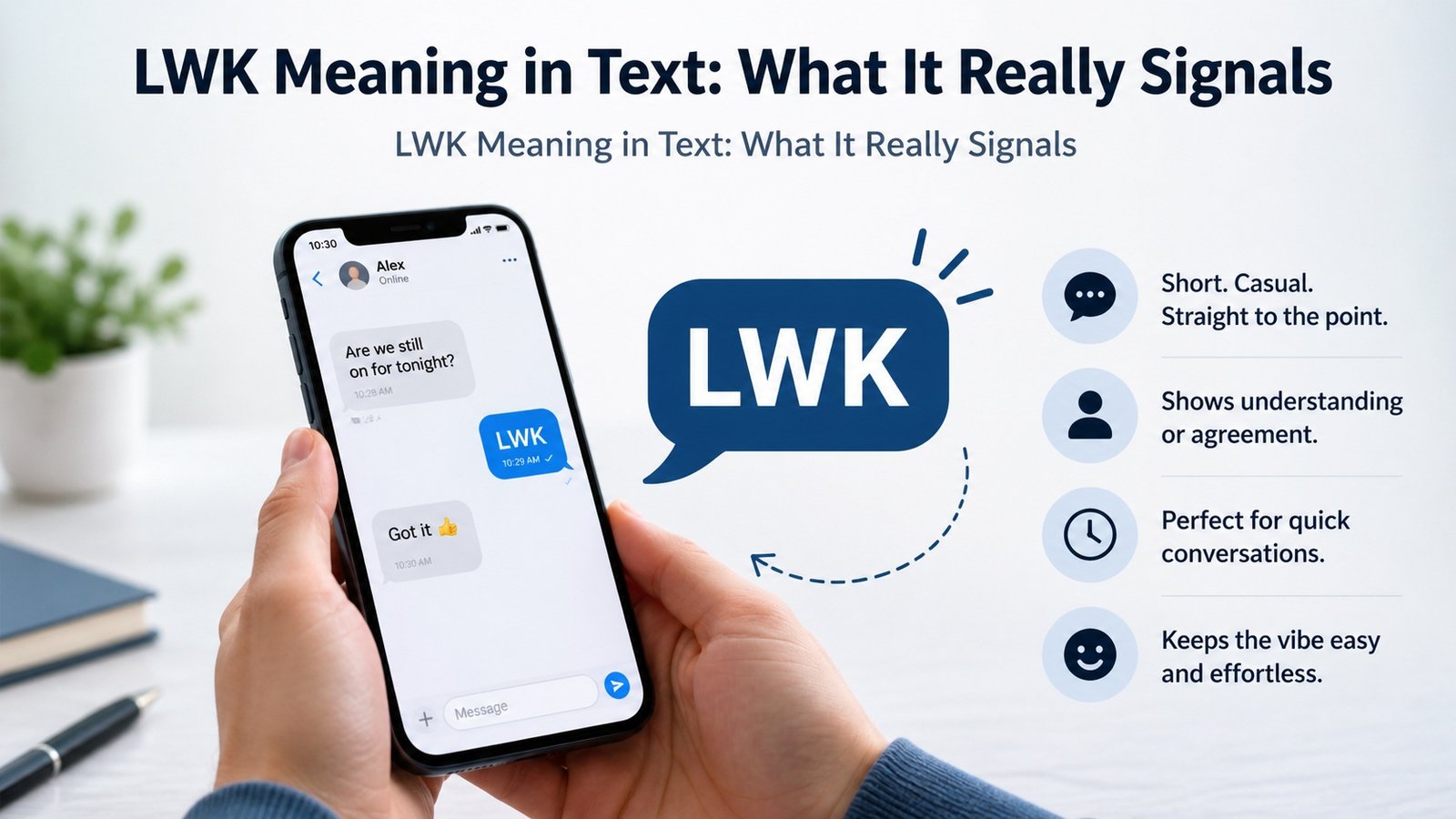
LWK might look like just another short internet phrase, but it carries a subtle tone that people pick up quickly. In everyday texting, small abbreviations often shape how a message feels, not just what it says. That’s exactly why people search for meanings like this.
Today, LWK appears in texts, social media captions, and casual chats across the United States. It’s not loud or dramatic. Instead, it quietly changes the emotional weight of a sentence. Because of that, it’s become a favorite for people who want to express something without sounding too direct.
So, what does LWK really mean, and why does it matter? Let’s break it down in a clear and relatable way.
Quick Answer
LWK Meaning in Text usually stands for “low-key,” which signals something subtle, understated, or not meant to be taken too seriously. In the U.S., it often softens opinions or feelings, making them sound casual or slightly hidden.
TL;DR
• LWK means “low-key” in most texting situations
• It softens statements to sound less intense
• Popular in U.S. social media and casual chats
• Often shows mild feelings or hidden opinions
• Can express humor, honesty, or understatement
• Tone depends heavily on context
What Does LWK Mean in Texting?
Understanding LWK starts with how it appears in real conversations. It’s rarely used alone. Instead, it modifies a sentence’s tone.
Everyday Usage
People use LWK to make statements feel lighter or less serious. It adds a layer of subtle honesty.
• “I LWK like that song” shows mild approval
• “That was LWK annoying” softens criticism
• “I LWK miss those days” hints at quiet nostalgia
• “She LWK snapped at them” adds casual emphasis
Why It Matters
In the U.S., tone matters a lot in digital communication. LWK helps avoid sounding too blunt or emotional.
Origin of LWK and “Low-Key”
LWK didn’t appear out of nowhere. It comes directly from the phrase “low-key,” which has a longer cultural history.
Early Meaning
Originally, “low-key” described something calm or not flashy. It was used in photography and art to describe softer lighting.
Cultural Shift
Over time, especially in American slang, the phrase evolved.
• Became common in casual speech in the late 1900s
• Gained popularity in urban and youth culture
• Transitioned into texting shorthand in the 2010s
• Shortened to “LWK” for faster typing
Today, LWK is simply a digital shortcut with the same emotional tone.
How LWK Is Used in American Culture
In the United States, communication often balances honesty with politeness. LWK fits perfectly into that space.
Social Context
People use LWK when they want to express something without fully committing to it.
• Sharing opinions without sounding strong
• Admitting feelings quietly
• Adding humor or irony
• Avoiding confrontation in messages
Cultural Tone
American texting culture values casual expression. LWK supports that relaxed style.
Emotional Meaning Behind LWK
LWK isn’t just about words. It carries emotional weight that changes how messages are perceived.
Subtle Feelings
It often signals feelings that are present but not overwhelming.
• Mild attraction or interest
• Slight annoyance or frustration
• Quiet appreciation
• Hidden honesty
Psychological Effect
Using LWK can make a person seem more approachable. It lowers the emotional intensity of a statement.
LWK in Social Media and Online Trends
Social media platforms helped spread LWK quickly. It’s now part of everyday digital language.
Common Platforms
You’ll see LWK used across many spaces:
• Instagram captions for subtle opinions
• TikTok comments for humorous understatement
• Twitter posts for casual reactions
• Snapchat messages for everyday conversations
Tone in Posts
It often adds relatability. People use it to sound real without oversharing.
LWK vs Similar Slang Terms
LWK isn’t the only phrase that softens meaning. However, it has its own unique tone.
Comparison Table
| Context | Meaning in the USA | Common Associations | Notes |
| LWK | Subtle or understated feeling | Casual honesty | Softens tone |
| High-key | Strong or obvious feeling | Bold expression | Opposite of LWK |
| Kinda | Slight agreement or feeling | Informal speech | Less expressive than LWK |
| TBH | Honest opinion | Direct truth | More blunt than LWK |
| IMO | Personal opinion | Neutral tone | Less emotional nuance |
Is LWK Always Positive?
Not necessarily. The meaning depends on the sentence and context.
Positive Uses
• “I LWK love this place” shows quiet enthusiasm
• “That was LWK impressive” expresses mild praise
Negative Uses
• “That was LWK rude” softens criticism
• “I LWK don’t like it” signals gentle dislike
Neutral Uses
Sometimes it simply adds tone without strong emotion.
Read More: SNM Meaning in Text: What It Signals Today
Cross-Cultural Meaning of “Low-Key”
While LWK is mainly used in English texting, the idea behind it exists worldwide.
Similar Concepts
Many cultures have ways to express subtle feelings.
• Japanese communication often values indirect expression
• British slang also uses understatement frequently
• Some European cultures prefer softer phrasing
Key Difference
However, LWK itself is strongly tied to modern American internet culture.
LWK in Relationships and Conversations
In personal communication, LWK plays a unique role. It can shape how messages are received.
Romantic Context
• “I LWK like you” suggests interest without pressure
• “I LWK miss you” shows gentle affection
Friendships
• Helps avoid awkwardness
• Keeps conversations light
• Allows honesty without intensity
Workplace Messaging
It’s less common in professional settings, but still appears in casual team chats.
Misunderstandings and Confusion Around LWK
Because it’s subtle, LWK can sometimes confuse readers.
Common Issues
• Some people think it means something else entirely
• Tone can be misread without context
• Older audiences may not recognize it
Clarifying Intent
If clarity matters, people often avoid abbreviations like LWK in serious conversations.
Controversies or Misuse
LWK itself isn’t controversial, but like any slang, it can be misunderstood.
Potential Problems
• Can make serious topics seem too casual
• Might weaken important statements
• Overuse can make messages feel unclear
Balanced Use
Using it sparingly keeps communication effective.
How LWK Has Changed Over Time
Language evolves fast, especially online. LWK reflects that shift.
Timeline
• Pre-2000s: “Low-key” used in speech
• 2010s: Popular in youth slang
• Late 2010s–2020s: Became “LWK” in texting
• 2025–2026: Widely recognized in digital culture
Modern Trend
Shortened phrases continue to grow as texting becomes faster.
Should You Use LWK?
That depends on your audience and message.
When It Works Best
• Casual conversations with friends
• Social media posts
• Lighthearted messages
When to Avoid It
• Formal emails
• Professional writing
• Serious discussions
Using it correctly shows awareness of tone and context.
FAQs
What does LWK stand for in text?
It stands for “low-key.” It means something subtle, mild, or not strongly expressed.
Is LWK the same as low-key?
Yes, LWK is simply a shortened version of “low-key” used in texting.
Is LWK positive or negative?
It can be both. The meaning depends on how it’s used in a sentence.
Do people still use LWK in 2026?
Yes, it’s still widely used, especially among younger audiences and on social media.
Can LWK be used in formal writing?
No, it’s best for casual communication. Formal writing should avoid slang abbreviations.
Why do people use LWK instead of low-key?
It’s faster to type and fits the quick style of texting and online messaging.
Conclusion
LWK may seem small, but it carries a lot of meaning in modern communication. It softens statements, adds subtle emotion, and helps people express themselves without sounding too strong. That balance makes it especially popular in the United States, where tone and delivery matter as much as the message itself.
As digital language continues to evolve, abbreviations like this will keep shaping how people connect. Understanding the LWK Meaning in Text gives you a clearer view of how people communicate today—and how even a few letters can change everything.

Fazal Abbas is an English language writer who focuses on making grammar clear and easy to understand. He explains complex rules in simple terms and uses practical examples to help readers improve their writing, speaking, and overall communication skills.