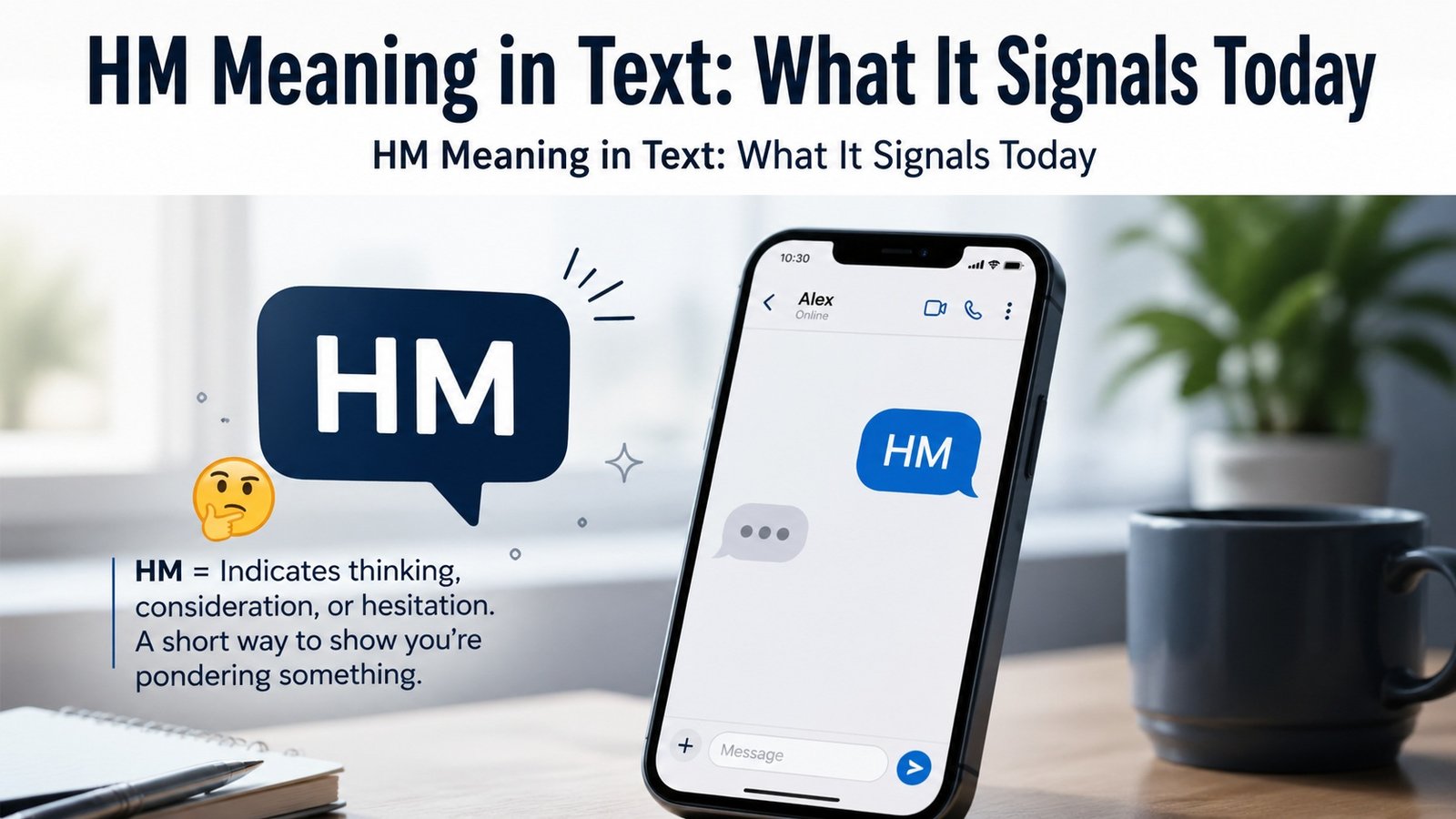
In everyday messaging, small signals often carry big meaning. One of the most common—and most confusing—is “HM.” You’ve probably seen it in texts, social media replies, or casual chats. At first glance, it looks simple. However, its meaning can shift depending on tone, timing, and context.
The phrase HM Meaning in Text matters because it reflects how Americans communicate today—quickly, subtly, and often without full sentences. In the USA, digital shorthand like “hm” has become a kind of emotional code. It can show curiosity, doubt, or even quiet disagreement, all without saying much at all.
So what does “hm” really signal? And why do people use it so often?
Quick Answer
HM Meaning in Text usually signals thinking, hesitation, or mild uncertainty in American communication. It can express curiosity, doubt, or a pause in conversation, depending on context.
TL;DR
• “HM” shows thinking, hesitation, or mild doubt
• Tone depends heavily on context and timing
• Common in casual US texting and social media
• Can feel neutral, curious, or slightly dismissive
• Meaning has evolved with digital communication habits
What Does HM Mean in Text?
Understanding “hm” starts with its simplest form. It’s not a word in the traditional sense. Instead, it’s a sound—a written version of a thoughtful hum.
Basic Definition
“HM” represents a thinking sound people make in real life. When typed, it mimics that pause in speech.
• A pause before responding thoughtfully
• A sign of mild confusion or curiosity
• A neutral reaction when unsure what to say
• A placeholder while processing information
In the USA, this shorthand feels natural because spoken habits often carry into digital spaces. People type how they think or speak.
Why It Matters in Conversations
Even though it’s short, “hm” can change the tone of a conversation.
• It can slow down fast-paced chats
• It may signal emotional distance or neutrality
• It often invites clarification without asking directly
• It can feel ambiguous, leading to misinterpretation
Because of this, “hm” is both useful and tricky at the same time.
Historical Roots of “Hm” as a Sound
Before texting existed, “hm” lived in spoken language. Its roots go back much further than digital communication.
Early Spoken Use
The sound “hm” has long been used in English to show thought or hesitation.
• Used in conversations to pause before answering
• Common in storytelling and reflective speech
• Often paired with facial expressions or tone
This makes it part of a broader human pattern. People across cultures use similar sounds to signal thinking.
Transition Into Digital Language
As texting grew in the early 2000s, spoken sounds moved into written form.
• Chat rooms and early messaging apps encouraged brevity
• Sounds like “um,” “uh,” and “hm” became text shortcuts
• Younger users adopted them quickly for casual tone
Today, “hm” feels natural in digital conversations because it mirrors real-life thinking pauses.
HM Meaning in Text in the USA
In American culture, “hm” reflects communication styles that value speed and subtlety. It’s widely used across age groups, though tone varies.
Common American Interpretations
In the USA, “hm” often carries these meanings:
• Quiet curiosity about what was said
• A soft way to express doubt or skepticism
• A neutral acknowledgment without strong emotion
• A pause before giving a full response
Cultural Context
American texting culture favors short, efficient replies. However, people still want to express emotion.
• “HM” balances brevity with emotional nuance
• It avoids sounding too direct or confrontational
• It fits casual, informal communication styles
Because of this, “hm” works as a flexible emotional signal.
Emotional and Psychological Meaning of “HM”
Even a small expression can carry emotional weight. “Hm” often reflects internal thought processes.
What It Signals Emotionally
“HM” can show different feelings depending on context:
• Curiosity about new or surprising information
• Doubt when something seems unclear
• Mild disagreement without direct confrontation
• Indifference or low emotional investment
Psychological Interpretation
From a psychological angle, “hm” acts like a buffer.
• It gives time to think before responding
• It reduces pressure in conversations
• It avoids immediate emotional reactions
In many cases, it helps people stay neutral while deciding how to reply.
Read More: HN Meaning in Text: What It Really Signals
Different Contexts and Meanings of HM
| Context | Meaning in the USA | Common Associations | Notes |
| Casual texting | Thinking or mild curiosity | Neutral tone | Most common usage |
| Argument or debate | Doubt or subtle disagreement | Skepticism | Can feel dismissive |
| Social media reply | Passive reaction | Indifference or reflection | Often brief and ambiguous |
| Romantic texting | Uncertainty or hesitation | Emotional distance | May signal mixed feelings |
| Work chat | Careful consideration | Professional neutrality | Less emotional, more reserved |
This table shows why context matters so much. The same “hm” can mean very different things.
HM in Social Media and Online Culture
Today, “hm” plays a key role in online interactions. It appears in comments, replies, and even memes.
Common Uses Online
• Reacting without fully engaging in discussion
• Showing subtle skepticism toward posts
• Indicating thought without typing long responses
• Adding a reflective tone to short replies
Why It’s Popular
Social media rewards speed and simplicity.
• “HM” is quick to type and easy to understand
• It leaves room for interpretation
• It fits minimalist communication trends
However, that same ambiguity can also lead to confusion.
HM in Relationships and Personal Conversations
In personal chats, “hm” can feel more loaded. People often read deeper meaning into it.
Positive Interpretations
• Thoughtful listening during a conversation
• Genuine curiosity about what was said
• Taking time before responding carefully
Negative Interpretations
• Lack of interest or engagement
• Passive disagreement or avoidance
• Emotional distance or hesitation
Because tone isn’t visible in text, misunderstandings happen easily.
Cross-Cultural and Spiritual Parallels
Although “hm” is common in English, similar sounds appear worldwide. They often carry similar meanings.
Global Sound Patterns
• Many languages use “hmm” or similar sounds
• These sounds signal thinking or hesitation universally
• They often appear in storytelling and conversation
Symbolic Meaning
In a broader sense, “hm” represents pause and reflection.
• A moment between thought and response
• A space for processing information
• A signal of internal dialogue
This gives it a subtle, almost symbolic role in communication.
Modern Usage in Identity and Expression
People don’t just use “hm” for communication. It also reflects personality and style.
Where You’ll See It
• Text messages and chat apps
• Social media comments and replies
• Online forums and discussions
• Casual workplace messaging
What It Says About the User
• Prefers subtle communication over direct statements
• Values reflection before responding
• May avoid confrontation in conversations
In this way, “hm” becomes part of digital identity.
Misunderstandings and Controversies
Despite its simplicity, “hm” can cause confusion.
Common Misinterpretations
• Seen as rude when intended as neutral
• Interpreted as disinterest or boredom
• Mistaken for passive-aggressive behavior
Why Misuse Happens
• Lack of tone or facial cues
• Different expectations across generations
• Context not clearly defined
Because of this, some people avoid using “hm” in important conversations.
How the Meaning of HM Has Changed Over Time
Language evolves, and “hm” is no exception.
Past vs Present
• Originally only a spoken sound
• Later became a written expression in early messaging
• Now a common digital shorthand
Current Trends (2025–2026)
• Used more casually across all age groups
• Often paired with emojis or punctuation for clarity
• Still ambiguous but widely understood
As communication continues to evolve, “hm” remains relevant.
When to Use (and Avoid) HM in Text
Knowing when to use “hm” can improve communication.
Good Situations
• Casual chats with friends
• Reflecting before giving a longer answer
• Responding without strong emotion
Situations to Avoid
• Serious or emotional discussions
• Professional or formal communication
• When clarity is important
In these cases, clearer language works better.
FAQs
What does HM mean in texting?
It usually means thinking, hesitation, or mild curiosity. The tone depends on context and timing.
Is “hm” rude in messages?
Not always. However, it can feel dismissive if used without explanation or follow-up.
What’s the difference between “hm” and “hmm”?
“HMM” often shows deeper thought or stronger emotion. “HM” feels shorter and more neutral.
Why do people use “hm” instead of words?
It’s faster and mirrors real-life thinking sounds. It also leaves room for interpretation.
Does “hm” mean someone is not interested?
Sometimes, but not always. It can also mean they’re thinking or unsure how to respond.
Is “hm” appropriate in professional chats?
Usually not. Clear and direct responses are better in work settings.
Conclusion
At first glance, it seems like just two letters. Yet the HM Meaning in Text reveals how modern communication works—quick, subtle, and layered with emotion. In the USA, “hm” acts as a flexible signal. It can show curiosity, hesitation, or even quiet disagreement, all depending on context.
Over time, it has shifted from a simple spoken sound to a digital expression of thought. Today, it plays a small but powerful role in conversations, especially online. Understanding it helps you read between the lines and communicate more clearly.
Next time you see “hm,” don’t rush to judge it. Instead, consider the tone, timing, and situation. Sometimes, what’s not fully said carries the most meaning.

Alyan Ashraf is a passionate English language writer who simplifies grammar for everyday learners. He focuses on clear explanations, practical examples, and common usage rules to help readers write better, speak confidently, and avoid mistakes in real-world English.