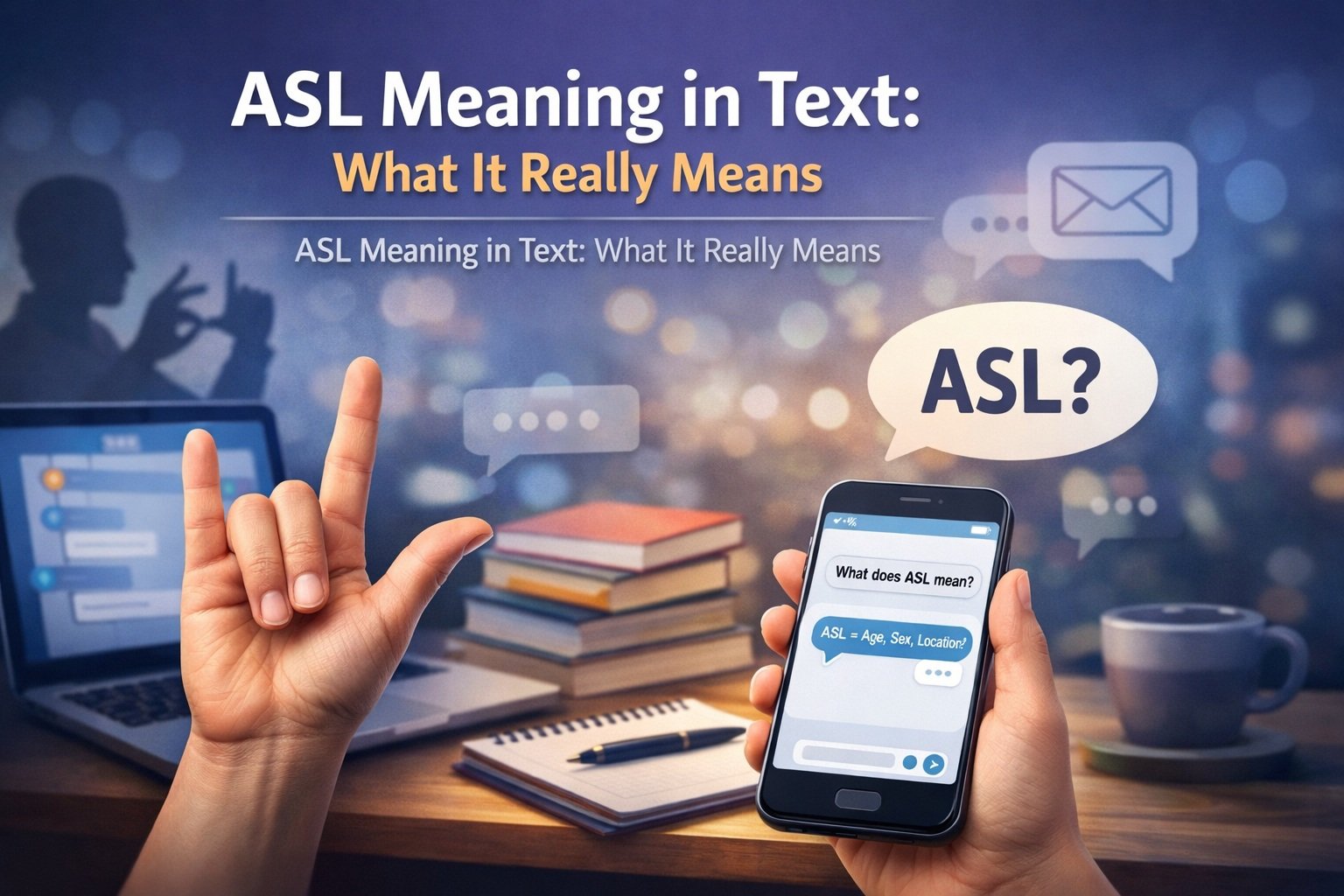
ASL shows up in texts, chats, and comments, often leaving people wondering what it really means. If you’ve ever seen “ASL?” pop up in a message, you’re not alone. This simple abbreviation has traveled across decades of internet culture and still appears today in American digital conversations.
At first glance, it looks like just another shorthand. However, ASL carries layered meanings depending on context, platform, and even generation. In the United States, it’s closely tied to early online chat culture, yet it continues to evolve in modern texting.
Because language online changes fast, understanding ASL helps you read tone, intention, and even identity signals. Let’s unpack where it came from, what it means now, and how people use it today.
Quick Answer
ASL Meaning in Text usually stands for “Age, Sex, Location” in American online culture. People use it to quickly learn basic details about someone in chats. However, in other contexts, it can also mean American Sign Language.
TL;DR
• ASL often means “Age, Sex, Location” in chats
• Originated in early internet chatrooms in the USA
• Also stands for American Sign Language
• Signals curiosity or social connection
• Still used today, though less common
• Meaning depends heavily on context
What Does ASL Mean in Texting?
In modern texting, ASL is a quick question. It’s short, direct, and often used to break the ice. For American users, it’s deeply tied to early online habits.
Basic Definition
ASL stands for:
• Age — How old are you
• Sex — Your gender identity
• Location — Where you live
Why People Use It
• Fast way to start a conversation
• Builds context in anonymous chats
• Helps people find relatable connections
• Often used in casual or informal spaces
Today, however, many people find it outdated or too direct. Because of that, its use has declined on mainstream platforms.
Origins of ASL in Early Internet Culture
To understand ASL, you need to go back to the early internet days. In the 1990s and early 2000s, chatrooms were booming across the United States.
Chatroom Era
People used platforms like AOL Instant Messenger and IRC. Since profiles were limited, users relied on quick questions.
• ASL became a standard opener
• Conversations started with minimal context
• Anonymity made basic info important
• Speed mattered in fast-moving chats
Why It Spread So Fast
Because typing was slower and less intuitive back then, abbreviations became essential. ASL was simple, easy, and widely understood.
Over time, it became part of internet identity itself.
ASL Meaning in the USA Today
In the United States, ASL carries both nostalgia and caution. While older users may recognize it instantly, younger users often interpret it differently.
Current Usage Trends
• Seen more in niche or older chat communities
• Occasionally used jokingly or ironically
• Rare in formal or professional communication
• Sometimes misunderstood by younger audiences
Cultural Tone in America
Today, asking “ASL?” can feel:
• Direct or intrusive
• Playful in the right context
• Outdated or even awkward
Because of changing norms, people now prefer softer questions like “Where are you from?”
ASL vs American Sign Language
Here’s where confusion often happens. ASL also stands for American Sign Language, which is completely different.
Two Meanings, One Acronym
• ASL (chat): Age, Sex, Location
• ASL (language): American Sign Language
Why This Matters
Context is everything. For example:
• In texting: likely chat slang
• In education: likely sign language
• In social media: depends on topic
Misunderstanding can lead to awkward moments, especially in serious conversations.
Emotional and Psychological Meaning
Even though ASL is just a question, it reflects deeper human behavior. People naturally want connection, context, and familiarity.
What ASL Signals
• Curiosity about identity
• Desire for connection
• Need for shared ground
• Social filtering instinct
Emotional Associations
• Neutral curiosity
• Slight vulnerability
• Sometimes suspicion or caution
Because it asks personal details, it can also trigger privacy concerns.
Modern Usage on Social Media and Apps
ASL hasn’t disappeared. Instead, it has adapted to new platforms and styles.
Where You Might See It
• Anonymous chat apps
• Gaming chats
• Meme culture
• TikTok or comment sections
How It’s Used Today
• Ironically to mimic old internet culture
• As a joke among friends
• Occasionally in serious conversations
However, most users now prefer more natural conversation starters.
Common Contexts and Meanings in the USA
Here’s how ASL shows up across different situations:
| Context | Meaning in the USA | Common Associations | Notes |
| Chatrooms | Age, Sex, Location | Early internet culture | Most traditional usage |
| Text messages | Personal details inquiry | Casual curiosity | Less common today |
| Social media | Joke or meme | Nostalgia, humor | Often ironic |
| Education | American Sign Language | Deaf community, learning | Completely different meaning |
| Dating apps | Basic info request | Filtering compatibility | Can feel too direct |
Cross-Cultural and Global Meanings
Outside the United States, ASL still appears in online spaces. However, its meaning can vary slightly.
Global Interpretation
• Widely understood in English-speaking countries
• Less common in non-English regions
• Sometimes replaced with local equivalents
Cultural Differences
In some cultures:
• Asking personal details upfront is normal
• In others, it feels intrusive
Because of that, ASL may be interpreted differently depending on cultural norms.
Read More:30 Other Ways to Say ‘have a good evening professionally’ (With Examples)
Misunderstandings and Controversies
ASL might seem harmless, but it has sparked debates over time.
Privacy Concerns
• Asking age and location can feel invasive
• Raises safety concerns in anonymous chats
• Especially sensitive for younger users
Outdated or Awkward Use
• Some view it as old-fashioned
• Others see it as socially blunt
• Can signal lack of conversational nuance
Confusion with Sign Language
Mixing up meanings can lead to:
• Miscommunication
• Unintended offense
• Confusing conversations
Because of this, context matters more than ever.
How ASL Has Changed Over Time
Language evolves, and ASL is no exception. What was once essential is now optional.
Then vs Now
• Then: standard chat introduction
• Now: occasional or ironic usage
What Replaced It
People now ask:
• “Where are you from?”
• “How old are you?” (later in conversation)
• “What do you do?”
Instead of one direct question, conversations feel more natural and gradual.
ASL in Identity and Digital Culture
ASL reflects how people present themselves online. It’s not just a question—it’s a snapshot of identity.
Identity Signals
• Age group
• Gender identity
• Geographic background
Cultural Meaning
It represents:
• Early internet freedom
• Anonymous interaction
• Curiosity-driven communication
Because of that, ASL is part of digital history, not just slang.
FAQs
What does ASL mean in texting today?
ASL usually means “Age, Sex, Location.” However, it’s less common now and often used jokingly or in niche chats.
Is ASL rude or inappropriate?
It depends on context. Some people find it too direct, while others see it as harmless curiosity.
Does ASL always mean Age, Sex, Location?
No. It can also mean American Sign Language. Context helps determine the correct meaning.
Why do people still use ASL?
Some use it out of habit or nostalgia. Others use it ironically in memes or casual chats.
Is ASL safe to answer?
Be cautious. Sharing personal details online can pose privacy risks, especially with strangers.
What should I say instead of ASL?
You can ask more natural questions like “Where are you from?” or “Tell me about yourself.”
Conclusion
ASL may look like a simple abbreviation, but it carries decades of digital history. From early American chatrooms to modern memes, its meaning has shifted with time and culture.
Today, ASL Meaning in Text still points to “Age, Sex, Location,” yet it also reflects how people connect, question, and present themselves online. While its use has faded in everyday conversation, its legacy remains strong in internet culture.
As communication continues to evolve, small phrases like ASL remind us how quickly language adapts. And sometimes, even the shortest questions can tell a much bigger story.

Fazal Abbas is an English language writer who focuses on making grammar clear and easy to understand. He explains complex rules in simple terms and uses practical examples to help readers improve their writing, speaking, and overall communication skills.