In today’s fast-moving digital world, short phrases often carry big meaning. One of the most common examples is WBU Meaning in Text Messages, a shorthand that appears in everyday chats, social media comments, and quick replies. At first glance, it may look like random letters, but it actually plays a key role in how people communicate quickly and casually.
This abbreviation reflects more than convenience. It shows how language adapts to speed, emotion, and connection. In the United States, where texting culture is deeply embedded in daily life, WBU has become a subtle social signal. It helps conversations stay flowing while keeping things friendly and informal.
To really understand it, you need to look beyond the letters and into the culture that shaped them.
Quick Answer
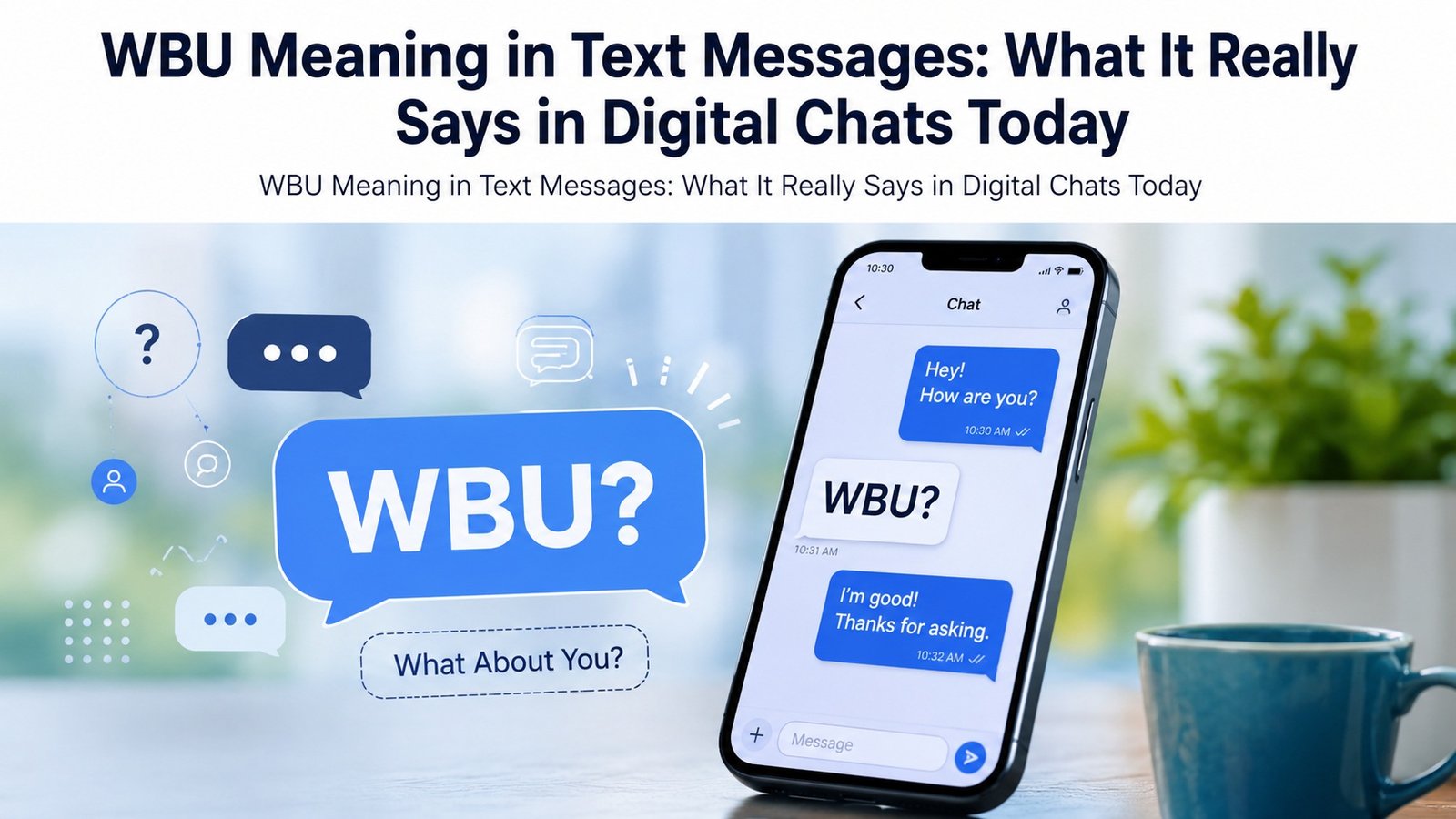
WBU meaning in text messages stands for “What About You?” In the USA, it’s commonly used to shift attention back to the other person in a conversation, keeping chats balanced and conversational while sounding casual and friendly.
TL;DR
- WBU means “What About You?”
- Common in casual texting and social media
- Used to return question back to the other person
- Reflects fast, informal digital communication
- Popular in American messaging culture
- Signals engagement and conversational balance
What Is WBU Meaning in Text Messages
This section explains the basic definition and usage of WBU Meaning in Text Messages. It’s one of the most common conversational shortcuts in modern digital language.
Basic Definition and Usage
WBU stands for “What About You?” and appears in casual conversations.
• Used after answering a question briefly
• Keeps conversation flowing naturally
• Common in texting, DMs, and chat apps
• Works as a conversational handoff
In simple terms, it’s a way to ask someone the same question back without repeating everything.
How WBU Appears in Digital Communication
WBU is not just a phrase. It’s a conversational tool shaped by digital speed and convenience.
Everyday Texting Context
People often use WBU in quick exchanges.
• After sharing personal updates
• During friendly check-ins
• In group chats or one-on-one texts
• When replying to greetings or questions
It keeps conversations light while still showing interest.
Origins of Internet Acronyms and Shorthand Language
To understand WBU fully, you need to see where it comes from historically.
Early Digital Communication Roots
Shortened language began with early messaging systems.
• SMS character limits encouraged shortcuts
• Early internet chatrooms shaped abbreviations
• Email culture introduced informal writing
• Mobile texting reinforced speed-based language
WBU belongs to a long tradition of digital efficiency.
Evolution of Texting Culture in the United States
In the USA, texting evolved into a dominant communication form. This shaped how abbreviations like WBU spread.
Rise of Mobile Messaging
Smartphones changed how Americans communicate daily.
• Faster communication replaced longer calls
• Social norms shifted toward short replies
• Messaging apps replaced traditional SMS
• Informality became widely accepted
As a result, WBU became part of everyday language.
WBU in American Messaging Habits
This section focuses on how WBU Meaning in Text Messages fits into USA communication styles.
Casual Conversation Patterns
Americans often use WBU to keep dialogue balanced.
• Used to avoid one-sided conversations
• Encourages mutual sharing
• Makes replies feel natural
• Reduces effort while staying polite
It reflects a culture that values both speed and friendliness.
Emotional Meaning Behind WBU
Beyond its literal meaning, WBU carries emotional tone in conversations.
Subtle Social Signals
WBU often expresses more than curiosity.
• Shows interest in the other person
• Maintains emotional connection
• Signals openness in conversation
• Softens direct questioning
It’s a small phrase with relational impact.
Psychological Role of Abbreviations in Communication
Short forms like WBU influence how people think and respond.
Cognitive Efficiency in Messaging
The brain processes shorthand quickly.
y = \text{communication speed} + \text{reduced cognitive load}
• Reduces mental effort during typing
• Encourages faster response times
• Supports multitasking behavior
• Reinforces habitual digital speech
Abbreviations make communication feel effortless.
Cross-Cultural Use of WBU and Similar Acronyms
While WBU is common in the USA, similar expressions exist globally.
Global Messaging Variations
Different cultures use different shorthand forms.
• UK users also adopt WBU widely
• Asian messaging apps use localized equivalents
• Some languages prefer full phrases
• Emojis often replace abbreviations elsewhere
Still, the intent remains universal: asking “and you?”
WBU in Social Media and Pop Culture
WBU is not limited to private chats. It appears across platforms.
Online Interaction Patterns
Social media has normalized abbreviations.
• Used in comments on posts
• Appears in casual influencer replies
• Common in story interactions
• Frequently used in memes or captions
It reflects how language adapts to digital spaces.
Read More: ATM Meaning in Text: What It Really Means in Modern Messaging
Common Misunderstandings of WBU
Not everyone interprets WBU the same way.
Confusion in Tone and Intent
Misunderstandings can happen easily.
• Some think it means disinterest
• Others misread tone as abrupt
• New users may not recognize abbreviation
• Context changes meaning significantly
Clarity depends heavily on conversation flow.
Misuse, Tone Confusion, and Communication Breakdowns
Like many abbreviations, WBU can sometimes cause issues.
When Meaning Gets Lost
Tone interpretation varies by reader.
• Overuse can feel impersonal
• Missing context leads to confusion
• Can seem dismissive in serious talks
• May weaken emotional clarity
Still, in casual chats, it works smoothly.
How WBU Reflects Modern Identity and Digital Speed
WBU represents more than language. It reflects how people live today.
Identity in Digital Communication
Modern communication values speed and connection.
• People prefer quick exchanges
• Efficiency shapes communication habits
• Identity is expressed through digital style
• Language becomes more flexible and adaptive
WBU is part of that evolving identity.
Comparison of WBU in Different Contexts
Here’s how meaning shifts depending on usage.
| Context | Meaning in USA | Tone | Usage Example |
| Text messages | What About You? | Casual | “I’m good, WBU?” |
| Social media | Asking back question | Friendly | “Loved it, WBU?” |
| Group chats | Inclusion prompt | Neutral | “We’re meeting later, WBU?” |
| Emotional talk | Check-in response | Warm | “I’m okay, WBU feeling?” |
This shows how flexible the abbreviation really is.
FAQs
What does WBU mean in text messages?
WBU means “What About You?” It is used to return a question back to someone in casual conversation.
Is WBU rude or polite?
It is generally polite in casual chats. However, tone depends on context and relationship.
Where is WBU commonly used?
It is mostly used in texting, social media messages, and informal digital communication.
Can WBU be used in formal writing?
No, WBU is informal and should not be used in professional or academic writing.
Is WBU used globally?
Yes, but it is most common in English-speaking countries like the USA.
What is the difference between WBU and U?
WBU asks for the other person’s response, while “U” is just a shortened “you.”
Conclusion
The WBU Meaning in Text Messages goes far beyond a simple abbreviation. It represents how modern communication balances speed, emotion, and connection. In the USA, it has become a natural part of everyday digital speech, reflecting how people stay engaged while keeping conversations light.
At its core, WBU shows that even the smallest phrases can carry social meaning. As communication continues to evolve, shorthand like this will keep shaping how people connect, respond, and understand each other in the digital age.

Alyan Ashraf is a passionate English language writer who simplifies grammar for everyday learners. He focuses on clear explanations, practical examples, and common usage rules to help readers write better, speak confidently, and avoid mistakes in real-world English.