In today’s fast-moving digital world, short phrases carry big meaning. One of the most widely used expressions is “FML,” a phrase that pops up in texts, memes, and social media posts. If you’ve ever seen someone type it after a bad day, you’re not alone. Understanding FML Meaning in Text reveals more than just slang—it reflects how people cope with stress and share emotions online.
At first glance, “FML” might seem blunt or even harsh. However, in everyday American communication, it often carries humor, exaggeration, or a sense of shared struggle. People don’t always mean it literally. Instead, they use it to express frustration in a quick, relatable way.
Because language evolves fast, especially online, phrases like this take on new layers of meaning. So, what does “FML” really signal today? Let’s break it down.
Quick Answer
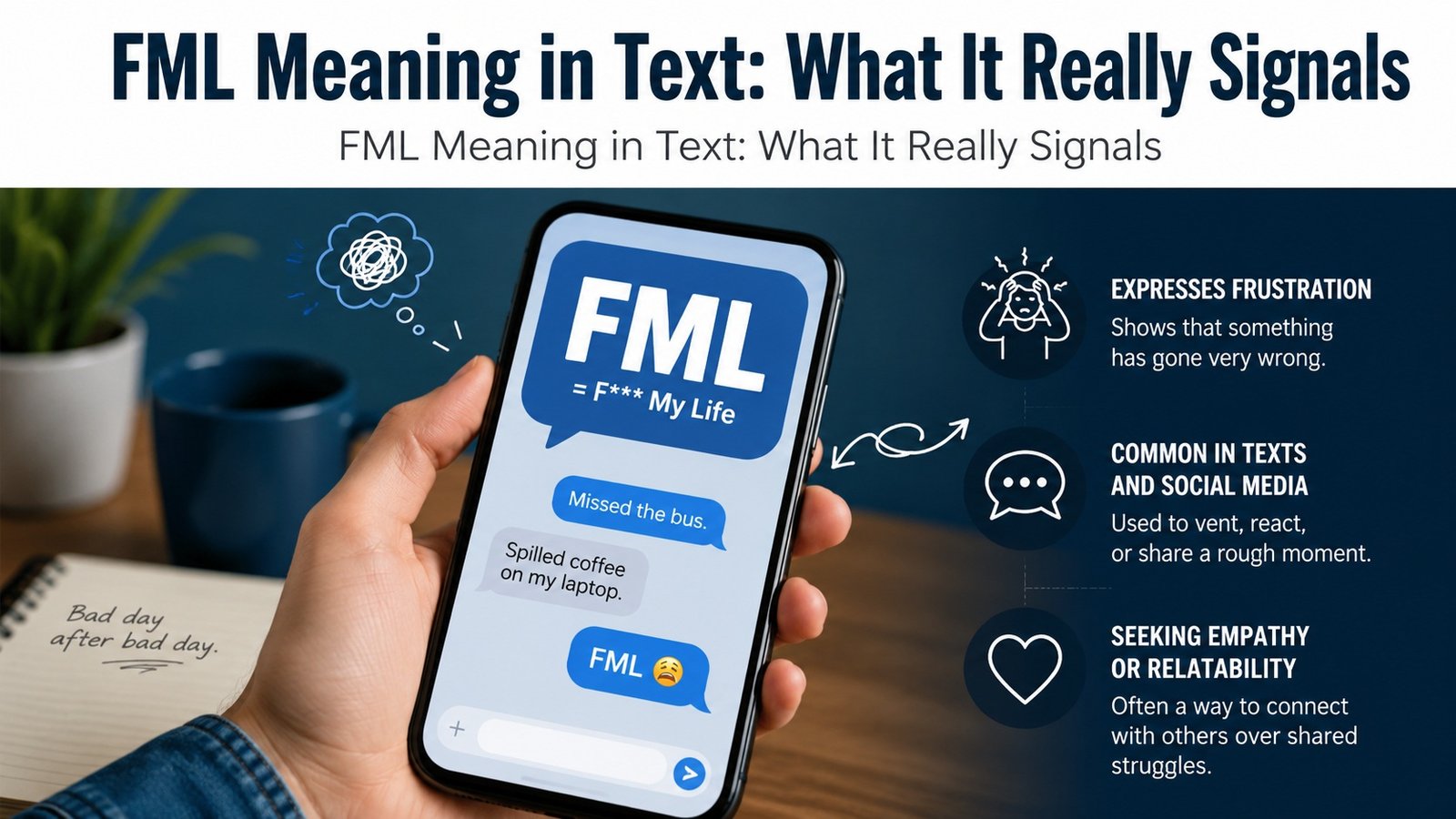
FML Meaning in Text usually stands for “F*** My Life,” and in the USA, it’s commonly used to express frustration, disappointment, or ironic humor about everyday problems. While it sounds intense, it’s often playful or exaggerated rather than deeply serious.
TL;DR
• Means “F*** My Life,” expressing frustration or bad luck
• Common in American texting, memes, and social media
• Often used humorously, not literally
• Reflects modern stress-sharing culture online
• Can signal sarcasm, exaggeration, or emotional release
• Tone depends heavily on context and relationship
What Does FML Mean in Texting?
In American texting culture, “FML” acts like a quick emotional shortcut. Instead of writing a long explanation, someone can type three letters and instantly convey their mood.
Everyday Usage
People use “FML” when something goes wrong, big or small. It might follow a missed alarm, a spilled drink, or a failed test.
• Forgot an important meeting and feel embarrassed
• Dropped your phone and cracked the screen
• Missed a deadline after working all night
• Got stuck in traffic during a rush day
• Burned dinner after a long day at work
Because of this, the phrase feels relatable. Most people recognize the feeling behind it.
Tone and Context
However, tone matters. In many cases, “FML” isn’t serious despair. Instead, it’s light sarcasm or dramatic humor. Among friends, it can even spark laughter.
Origins of FML: Where Did It Come From?
To understand the phrase fully, it helps to look at its roots. “FML” didn’t start as just texting slang—it grew from earlier cultural expressions.
Early Digital Culture
The phrase gained traction in the mid-2000s, especially through online platforms. A major boost came from the website “FMyLife,” launched around January 2008, where users shared short stories of unfortunate events.
• Inspired by French phrase “Vie de merde” (meaning “life sucks”)
• Became popular during early social media growth
• Spread through forums, blogs, and later mobile texting
• Reinforced by meme culture and viral sharing
Evolution Over Time
At first, the phrase felt more shocking because of its explicit wording. Over time, though, it softened. Today, many people use it casually without focusing on the literal meaning.
Why Americans Use FML So Often
In the United States, communication often values speed and relatability. “FML” fits perfectly into that style.
Cultural Fit
American culture tends to normalize sharing everyday struggles, especially online. People openly discuss stress, work pressure, and minor frustrations.
• Encourages quick emotional expression
• Feels informal and conversational
• Matches humor-driven online culture
• Builds connection through shared experiences
Social Bonding
Interestingly, saying “FML” can create connection. When someone shares a bad moment, others respond with empathy or humor.
Read More: SP Meaning in Text: What It Signals Today
Emotional and Psychological Meaning
Beyond the words, “FML” reveals how people process emotions.
Emotional Signals
Although it sounds extreme, it usually signals mild frustration rather than deep despair.
• Feeling overwhelmed by small problems
• Expressing annoyance in a safe, quick way
• Seeking validation or sympathy
• Using humor to cope with stress
A Coping Mechanism
In many cases, it acts like a pressure valve. Instead of bottling emotions, people release them with a short phrase.
FML in Social Media and Meme Culture
Social media gave “FML” a second life. Today, it thrives in memes and viral content.
Visual and Viral Use
Memes often pair “FML” with relatable images—like spilled coffee or broken gadgets.
• Used in captions for funny fails
• Appears in TikTok and Instagram posts
• Often paired with exaggerated storytelling
• Encourages engagement through relatability
Because of this, the phrase feels less negative and more humorous in online spaces.
Is FML Always Negative?
Not necessarily. While it expresses frustration, it often carries a playful tone.
Shades of Meaning
The meaning depends on context, tone, and relationship between people.
• Light sarcasm among friends
• Dramatic humor for small problems
• Genuine frustration in serious situations
• Self-aware exaggeration
So, it’s not always as harsh as it sounds.
Common Situations Where FML Is Used
You’ll see “FML” across many everyday scenarios.
Typical Contexts
• School stress or missed assignments
• Workplace mistakes or long hours
• Relationship misunderstandings
• Tech failures like lost files
• Minor accidents or bad luck moments
These situations highlight how universal the phrase has become.
Table: FML Meaning Across Contexts
| Context | Meaning in the USA | Common Associations | Notes |
| Texting friends | Light frustration or humor | Sarcasm, exaggeration | Usually not serious |
| Social media | Relatable failure | Memes, viral humor | Often exaggerated |
| Workplace chats | Mild stress expression | Burnout, deadlines | Depends on professionalism |
| Personal messages | Emotional release | Stress, disappointment | Tone varies by relationship |
| Pop culture | Comedic bad luck | Storytelling, irony | Reinforced by internet trends |
Cross-Cultural and Global Meanings
Although “FML” is widely used in the USA, it has spread globally.
Global Adaptation
Different cultures interpret it slightly differently. However, the core idea remains similar.
• Seen as casual slang in many English-speaking countries
• Sometimes viewed as rude in formal cultures
• Often adopted through American media influence
• Translated or adapted into local expressions
Because of this, understanding context becomes even more important.
Misunderstandings and Controversies
Despite its popularity, “FML” can be misunderstood.
Potential Issues
Some people take the phrase literally or find it offensive.
• Contains profanity, which may offend some audiences
• Can seem overly negative in serious contexts
• Not appropriate for formal communication
• May signal deeper distress if used frequently
When to Avoid It
In professional or formal settings, it’s best to avoid using “FML.” It may come across as unprofessional or insensitive.
How Meaning Has Shifted Over Time
Language evolves, and “FML” is a clear example.
From Shock to Humor
Originally, the phrase felt bold and edgy. Today, it’s much more normalized.
• Early use emphasized shock value
• Later use focused on humor and relatability
• Now widely accepted in casual communication
• Continues evolving with digital culture
Because of this shift, many users don’t even think about its literal meaning anymore.
FML and Identity Expression
Interestingly, the phrase can reflect personality and communication style.
What It Signals About You
Using “FML” may suggest a casual, expressive, or humorous tone.
• Comfortable with informal language
• Open about sharing struggles
• Uses humor to cope with stress
• Engages with modern digital culture
However, overuse might also signal frequent frustration or negativity.
Alternatives to FML in Text
Sometimes, people choose softer or more polite options.
Common Alternatives
• “My day is not going well”
• “What a mess”
• “This is frustrating”
• “Just my luck”
• “Today is rough”
These alternatives work better in professional or mixed audiences.
FAQs
What does FML mean in texting?
It stands for “F*** My Life.” People use it to express frustration or bad luck, often in a humorous way.
Is FML offensive?
It can be, because it includes profanity. However, many people use it casually among friends without offense.
Do people use FML seriously?
Sometimes. While often humorous, it can reflect real frustration depending on context.
Is FML appropriate at work?
Usually not. It’s informal and may appear unprofessional in workplace communication.
Why is FML so popular?
It’s short, expressive, and relatable. People connect with shared moments of frustration.
Are there safer alternatives to FML?
Yes. Phrases like “This is frustrating” or “Just my luck” convey similar feelings without profanity.
Conclusion
At its core, FML Meaning in Text goes beyond a simple phrase. It captures a modern way of expressing frustration, humor, and shared human experience. In the United States, it reflects a culture that values quick communication and emotional honesty, often wrapped in humor.
Over time, the phrase has shifted from shocking slang to a common, almost playful expression. While it still carries strong language, most people use it lightly rather than literally.
If you see “FML” in a message, look at the context. Chances are, it’s less about despair and more about a relatable moment we’ve all experienced.